
AEO vs GEO vs SEO: What Is the Difference and Which Do I Need?
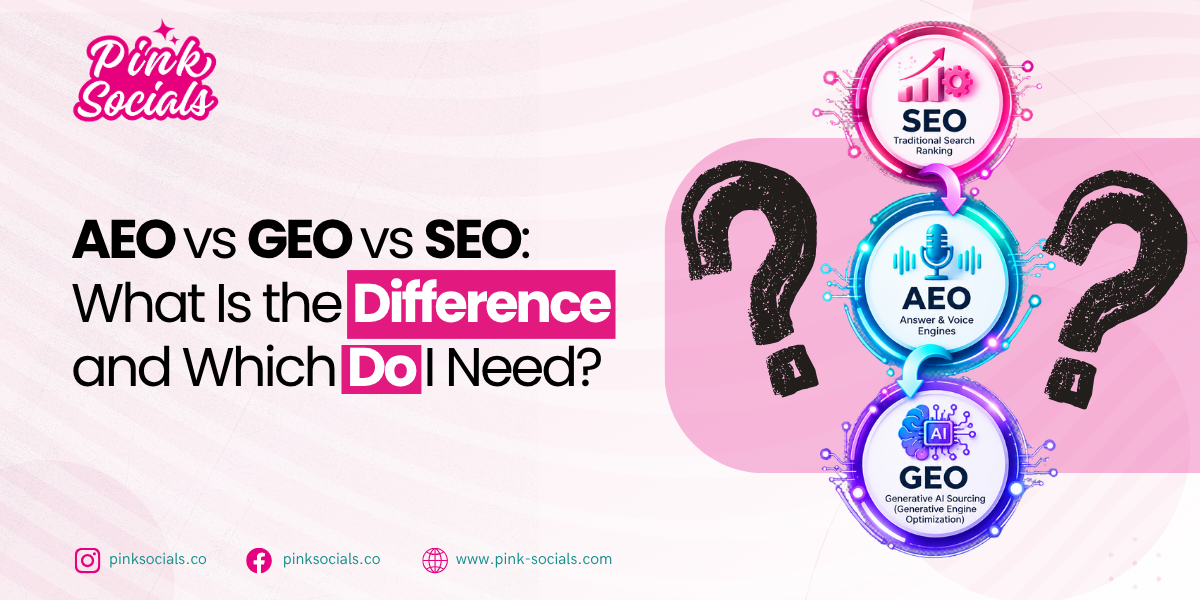
There is no indication whether it’s a new discipline or a new invoice line. AEO vs GEO vs SEO is about this. One is based on 20 years of documentation, one is a description of a real change in the way content should be written, and one has no agreed definition whatsoever. This guide helps you distinguish them and which ones you need.
This guide explains:
- What each of the three terms means
- Where each came from and who uses it
- How much of the underlying work is identical
- The two things that are genuinely new
- The questions to ask an agency selling GEO as a separate service

What is the difference between AEO, GEO and SEO?
SEO is the tried-and-true field of getting traffic from search engines, AEO is the new discipline of building an answerable page, and GEO is a newer term that hasn’t been defined. Generally, GEO refers to visibility within generative assistants. This page explains the meaning of each of these terms, how they compare, and what to purchase.
What does each term actually mean?
They all have the same goal, which is the source they select in mind, and they only differ in the system that they are thinking of and how new the word is. The following table lists the origin of each term and the usage of each term.
| Term | Stands for | Where it came from | What it denotes in practice | A distinct discipline? |
|---|---|---|---|---|
| SEO | Search engine optimization | In use since the late 1990s, with two decades of first-party documentation from search engines | Making a site findable and preferred in search results: technical access, content quality, structure, authority, local signals | Yes, established |
| AEO | Answer engine optimization | Coined by practitioners as featured snippets and voice answers grew, well before generative assistants | Structuring content so a specific answer can be extracted and credited: question headings, self-contained passages, tables, entity clarity | A practice inside SEO, not beside it |
| GEO | Generative engine optimization | Recent, coined in the generative assistant era, with no agreed definition and no governing source | Used to mean entity consistency, citation building, prompt testing, or whatever the seller already did under another name | Not yet. Ask what is in the scope |
SEO is the oldest of the three, and has the most documentation, since search engines have published guidance about SEO for two decades. This standard is even older than all three labels, and is documented in Google’s guidance on creating helpful content. It still describes most of the work: content made for people, with real expertise and a clear purpose behind it, however the page is produced.
So, what is answer engine optimization? It’s organizing content in a way that allows a specific answer to be pulled out and attributed, an approach that predates generative assistants and featured snippets, and voice answers. In practice, it’s question headings, self-contained passages, tables and a clear entity behind the page.
And what is generative engine optimization?It is a new term and there is no consensus on its definition; it was coined in the age of generative assistants. Sellers call it entity consistency, citation building, quick testing or whatever they did before by another name.
Some readers arrive expecting something else, because GEO also gets used for geographic search. That is a different job, and our local SEO page covers ranking in a specific area in full, including the signals that matter for map results and nearby searches, such as business listings, reviews and consistent contact details across the web.
How much of the work is actually the same?
Most of it, because crawlability, consistent business details, structured data, third-party corroboration, question-led headings and named authors would be under all three and precede two of them.
The table below shows how 10 tasks are assigned to the labels claiming them. Count rows by yourself.
| The actual task | Claimed by SEO | Claimed by AEO | Claimed by GEO |
|---|---|---|---|
| Make pages crawlable and renderable | Yes | Yes | Yes |
| Keep business details consistent everywhere | Yes | Yes | Yes |
| Publish Organization and LocalBusiness structured data | Yes | Yes | Yes |
| Earn mentions and citations on third-party sites | Yes | Yes | Yes |
| Write question-led headings | Yes | Yes | Yes |
| Put a self-contained answer under each heading | Sometimes | Yes | Yes |
| Name the author and show credentials | Yes | Yes | Yes |
| Decide which AI crawlers may access the site | Rarely | Sometimes | Yes |
| Run a monthly prompt log against the assistants | No | Sometimes | Yes |
| Build internal links and site architecture | Yes | Sometimes | Rarely |
Six of the ten rows are claimed by all three labels. There are two new rows that are really new: crawler policy and prompt-level measurement.
The overlap is not by chance: Google’s own announcement that the basics of the subject apply in determining eligibility for AI features is the best proof. According to Google’s documentation on AI features and your website, there are no extra requirements to be included in AI Overviews or AI Mode, and no special optimizations needed. Labels with a common eligibility rule have a common “core work.
The honest aeo vs seo difference is emphasis: AEO is the component of SEO that takes the most pride in the way that an answer is formed.
What is genuinely different about optimizing for AI answers?
Two points: Content needs to withstand being ripped out of its page and remain true, and crawler access and quick measurement are now choices that a business must make purposefully. The shift is real, even if the vocabulary is inflated. The intent of the query still determines the goal of the person, but the system now constructs an answer from bits of multiple pages. The first change is that of the format: A passage that makes sense only within its page cannot be taken out of it. Answering the question requires each section to be answered separately and page-level answer preparation rewrite the opening of each section to make it answerable by itself. The detail then sits underneath for the reader who wants more.
But the planning also changes, since the content must now be able to answer actual questions, and not just a keyword. The content side of this we take care of by taking the customer’s questions and creating pages to address each one individually. Each page is then read by the reader and secondly by the extractor.
Google’s AI answers are built from pages in its own index, so ranking still matters there, and position works differently on other assistants. Our guide to how the answer block selects pages explains the mechanism on Google’s side. It also shows what to change on a page and what to leave alone.
Assistants such as ChatGPT and Perplexity use retrieval, fetching pages live and weighing corroboration more than position. That’s the business side of the changeover: a business must be easily identifiable as a business. Our guide to what the retrieval assistants weigh explains the checks an assistant runs before it names a business, and which of them you can fix this month.
There are two things that are new. Now it’s a business choice, not a default, to determine which AI crawlers can read your site. To determine if assistants name you, you need a prompt log as there is no standard report that displays this.
Should I use the word GEO?
Whatever word you use, but don’t let the word set the scope; if there is no agreed definition for a word, then it will not tell you what you are buying.
These terms are used on our own service pages as they are the terms used by buyers when searching. It’s a fair reason, and it’s also why we keep our eyes closed on what’s contained within each.
Other people ask, “is Geo the same as seo”. Most content is the same, but the scope of the label is not agreed. So ask what’s in it.
Which do I need?
One program, not three, because the same work earns visibility in search results and in generated answers, and separate retainers duplicate cost without adding capability.
If you search “do i need geo“, the answer is that you need the work, and you need it once. Everything in the overlap table above belongs in one scope, owned by one team and reported on one calendar. Our SEO page shows how the three run together as one engagement, so a task is never billed twice under two names, and the work is easy to follow from the first audit to the monthly report.
The mix does depend on your business. A local service business needs entity consistency and local signals first. A publisher needs crawler policy decided on purpose, and an ecommerce catalog needs structure at scale.
Because the mix looks quite different for each and every kind of company that we work with, our industry pages show how the mix differs by sector, so you can see which tasks carry the most weight for a business like yours, from home services to medical practices, and which can wait.
What should I ask an agency selling GEO as a separate service?
Ask what tasks are in scope, which of them are not already in the SEO scope, how the result will be measured, and what the baseline is today.
Here are the four questions, written so you can copy them:
- Which tasks are in the scope of this service?
- Which of those tasks are not already in the SEO scope?
- How will the result be measured?
- What is the baseline today?
Before you trust any promise in a proposal, read what Google itself says about hiring help, because the page is short and plain. Google’s guidance on whether you need an SEO warns that no one can promise a top ranking, which is a useful test for any GEO guarantee. The same page is the right authority on how to vet who you hire.
Before you sign anything, get a baseline from someone with nothing to sell you beyond the audit itself. We suggest an independent audit first, because it shows what is already in place on your site and what each proposed line item would actually change.
If a proposal splits one job into separate retainers, ask for the scope of each. To see what a fair scope looks like in practice, our pricing page explains how engagements are scoped, so you can compare every line item with the work in the overlap table. A GEO line item that contains schema markup, consistent business details and question-led headings is an SEO line item with a new name, and you are entitled to say so.

How would I know which is working?
Measure each surface separately, because search clicks, AI Overview exposure and assistant citations behave differently, and a single blended traffic number hides all three.
The method takes a few steps and a little patience, so we wrote it up in full elsewhere. Our guide on measuring each surface separately gives the hostnames to watch, the report build, the prompt log and the monthly review, with each step spelled out in plain words.
AEO, GEO and SEO: what to actually do
On AEO vs GEO vs SEO, get the fundamentals right, restructure pages so answers survive extraction, decide crawler policy on purpose, add a prompt log, and buy one program with the scope written down.
- Get the fundamentals right, because they serve all three.
- Restructure pages so answers survive extraction.
- Decide crawler policy on purpose.
- Add a prompt log to reporting.
- Buy one program and make the scope explicit.
The terms will keep changing, and at least one of them will probably be gone in two years. The work in the overlap table will not.
Want to see how this works for your business? If you would like a specialist to check a proposal against the table, Pink Socials will show you which tasks are already covered, which are new, and what a fair scope looks like for one program.



Leave a Reply