
Does Google Penalise AI-Written Content in 2026?
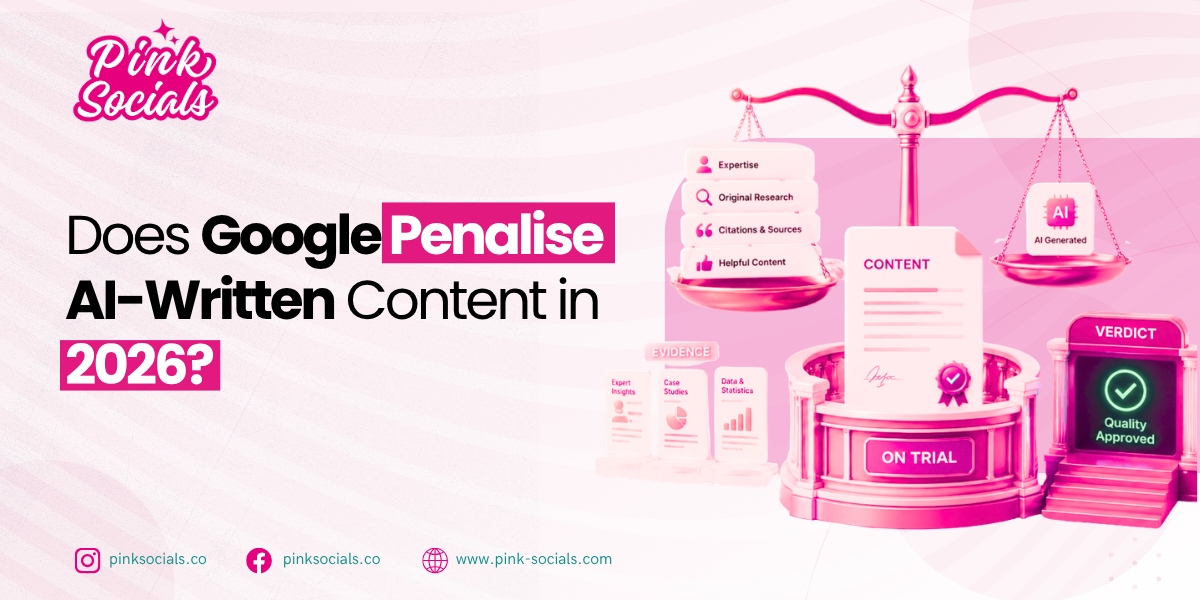
You have been told AI content will get your site penalized. You have also been told everyone is using it. Both cannot be right. So, does Google penalize AI content? Google’s published position is narrower than the advice around it. Helpful, original content is the standard, and content generated at scale to manipulate rankings is the violation.
This guide explains:
- What the spam policies actually say
- What the abuse policy means, and what it does not
- Why some sites publishing AI content do lose traffic
- A five-question test for pages you already published
- Whether you have to disclose AI use

Does Google penalize AI-written content?
No, not for being AI-written. Google’s guidance asks whether content is helpful and original, and its spam policy targets pages made to manipulate rankings, “no matter how it’s created.”
Those are two separate statements: a quality standard and a rule against a purpose.
| The claim you have heard | What the published documents say |
|---|---|
| “Google penalizes AI-written content” | The guidance asks about quality and purpose. The spam policy applies “no matter how it’s created.” |
| “Google detects AI writing and demotes it” | Neither page we cite describes detecting a writing method as a ranking input. |
| “Publishing AI content gets you a manual action” | The spam policies say policy-violating practices can result in a manual action. The trigger is the practice, not the tool. |
| “You must label AI-assisted content” | Neither page sets a labeling rule. Disclosures are useful where readers might wonder how content was made. |
| “Human-written content is safe by default” | The spam policy judges value to users, so a person can break it too. |
| “Scaled content abuse means publishing a lot” | The policy turns on purpose, not volume alone: many pages made mainly to manipulate rankings. |
What do the spam policies actually say?
The spam policies describe scaled abuse by purpose and value, targeting many pages generated mainly to manipulate search rankings, with no reference to which tool produced them.
Here is the wording itself, because the exact words matter more than any summary of them. Every quote in this section comes from Google’s spam policies, which say scaled content abuse “is when many pages are generated for the primary purpose of manipulating search rankings” and not helping users. It adds that this is typically “large amounts of unoriginal content” that offers little value, “no matter how it’s created.”
Generative AI is named, but only in one form: “using generative AI tools or other similar tools to generate many pages without adding value for users.”
A violation can mean sites “may rank lower in results or not appear in results at all.” Google finds problems through automated systems and, as needed, human review, which can result in a manual action.
A manual action and an algorithmic reassessment are different events. In our experience, a manual action appears as a message in the Search Console Manual actions report. An algorithmic change has no message, so you see a drop and have to work out why.
There is no separate Google AI content policy, so these two pages are the published record. Policy is not the same as how every system behaves, and Google’s wording has changed before.
Can Google detect AI writing? The pages we cite do not describe it as a ranking input, and we do not endorse third-party detectors.
What does “helpful content” mean in practice?
The helpful content guidance sets out questions about originality, expertise, purpose and reader satisfaction, which together form a standard you can measure any page against before it publishes. The standard is written down in public, so you can check it yourself, and every claim in this section comes from Google’s guidance on creating helpful content, which is worth reading in full before you judge any draft, whether it is yours, a freelancer’s or a model’s. Three questions matter most: does it give original information, research or analysis; is it written or reviewed by someone who demonstrably knows the topic; and was it created mainly to help people?
AI-assisted drafting tends to fail all three. A model has no results of its own, so it cannot offer original insight or first-hand experience. A draft ordered for keyword volume has no reason to exist beyond it.
AI-generated content ranking depends on the same things as any other content. The guidance calls “using generative AI to produce large amounts of text without manual oversight or curation” a sign of little effort.
So why do sites publishing AI content lose traffic?
Volume without originality produces pages nobody needed, and a site filling with pages that satisfy nobody loses visibility for reasons that have nothing to do with how the text was typed. Is AI content bad for SEO? Only when it fills a site with unreviewed pages, which is a site diluting itself, not a penalty.
After six months, a site that publishes three unreviewed AI drafts a week has forty near-identical pages on “how to choose a plumber.” None has a price, a photo or a real job behind it, and traffic drifts down.
That is thin content, and a person can make it just as easily. If you want to see which pages earn clicks and which only sit there, our SEO team can report on the search performance of published pages across the whole site, page by page, so you can tell which pages do real work and which ones only take up room in the index.
The fix starts before anything is published, with a short review of every draft. Our on-page team runs a set of quality checks before a page goes live that cover headings, search intent, duplicate topics and whether a draft says anything the site has not already said to its readers.
The five-question test
Apply five questions to any published page: does it hold something only you could write, did a named person review it, would you send it to a customer, is it needed, and would removing it cost anything?
| Question about the page | Why it decides the answer |
|---|---|
| 1. Does it contain something only you could have written: a result, a method, a case, a figure you own? | Originality comes first, and a model cannot supply it. |
| 2. Did a named person with relevant experience review it before it published? | Review separates assisted from automated. |
| 3. Would you send this page to a customer who asked the question? | It is the people-first test, made usable. |
| 4. Does it exist because someone needed the answer, or because a keyword had volume? | Purpose is what the abuse policy turns on. |
| 5. Could you remove it and lose nothing? | If yes, it was never an asset, whoever wrote it. |
Any “no” is where the risk sits. The test works the same way on human-written pages, which is the point.
What a safe process looks like
That is a process question more than a tool question, and every page needs the same editorial review before it ships. Our content marketing page covers how content gets planned and edited, from the brief and the angle to the review step that finally decides whether a page goes out to readers.
Some teams would rather hand the writing to someone else, and that is fair when the standard stays the same. Our drafting service covers who writes and edits the work, with a named person responsible for each page from first draft to final pass and a record of who checked it.
Do I have to disclose that I used AI?
No published Google requirement obliges you to label AI-assisted content, though naming the author and the reviewer serves the trust standard the guidance describes and is worth doing anyway.
The helpful content page says AI or automation disclosures are useful where someone might wonder how the content was made.
Now our opinion, not Google’s. We think you should name a human author, name a reviewer, and be able to say who checked the page. We suggest the same habit for yours, and readers can see who reviews what we publish on our team page, with a name and a role beside each person and a short note on their experience.
Other duties may apply in regulated sectors, and none of this is legal advice.

What if I already published a lot of it?
Audit it against the five questions, improve the pages with something real behind them, consolidate near-duplicates, and remove the ones that would cost nothing to lose.
Work in that order: protect pages that earn traffic or leads, merge near-duplicates and redirect the rest, then delete what fails question five. Be realistic: a site with hundreds of thin pages is a months-long cleanup, and no quick fix exists.
Do not start deleting until you have the full picture. For a view of the whole site, we can also give you an independent look at what you published, so you can see which pages to keep, which to merge and which to remove from the site before anyone touches it.
Where does AI genuinely help?
Research, outlining, first drafts of routine sections, reformatting, and summarizing material you already own all help, provided a named human does the thinking and the final pass.
It saves time on turning your own call notes into an outline and tidying a long draft. It reliably fails when asked for facts it cannot know or a case study that never happened.
The tools work best inside a routine, with a person reading every draft before it reaches your site. Our automation work builds AI tools with a process around them, so each step has a clear owner, and nothing is published without a human check on the final page before launch.
Capacity is where the case is strongest, because one person usually has to write, publish and still run the whole business. For owners writing their own content, AI can turn an hour of rough notes into a clean first draft, which makes a steady blog easier to keep going.
Does AI-written content get cited in AI answers?
Eligibility for AI features follows the same fundamentals as ordinary search visibility, so content with no original substance is no more likely to be selected as a source than to rank.
The central question is whether AI-written pages get a different route into AI answers, and Google’s own documentation answers it directly. Google’s page on AI features and your website says there are no additional requirements to appear in AI Overviews or AI Mode, and that SEO best practices remain relevant.
Pages that do get picked tend to answer a specific question clearly, and our guide to Google’s AI Overviews explains what gets selected for the answer block, with the page changes that make a source easier to extract, quote and credit in a finished answer for the reader.
Because the labels around all this change every few months and half of them mean the same thing, our guide to the vocabulary around all of this separates the terms that describe real work from the ones that exist only to describe a sales pitch to a busy buyer.
Using AI in content without a Google penalty
So, does Google penalize AI content? Not for the tool. It acts on scaled, unhelpful content made to manipulate rankings, and these steps keep you clear.
- Read the two policy documents yourself, not a summary of them.
- Judge pages on purpose and originality, not on production method.
- Put a named reviewer on everything.
- Run the five questions before publishing, not after.
- Audit what you already shipped.
One last limit: published policy and system behavior are not always the same, and anyone claiming to know exactly what triggers a demotion is describing their theory, not Google’s.
Want a process you can show a skeptical client, a reviewer or your own team? If you would like help setting the standard, the review step and the audit, Pink Socials will build them with you so your content stays useful and your team knows who owns each step of the work.
Leave a Reply