
Google Ads vs Facebook Ads: Which to Start With?
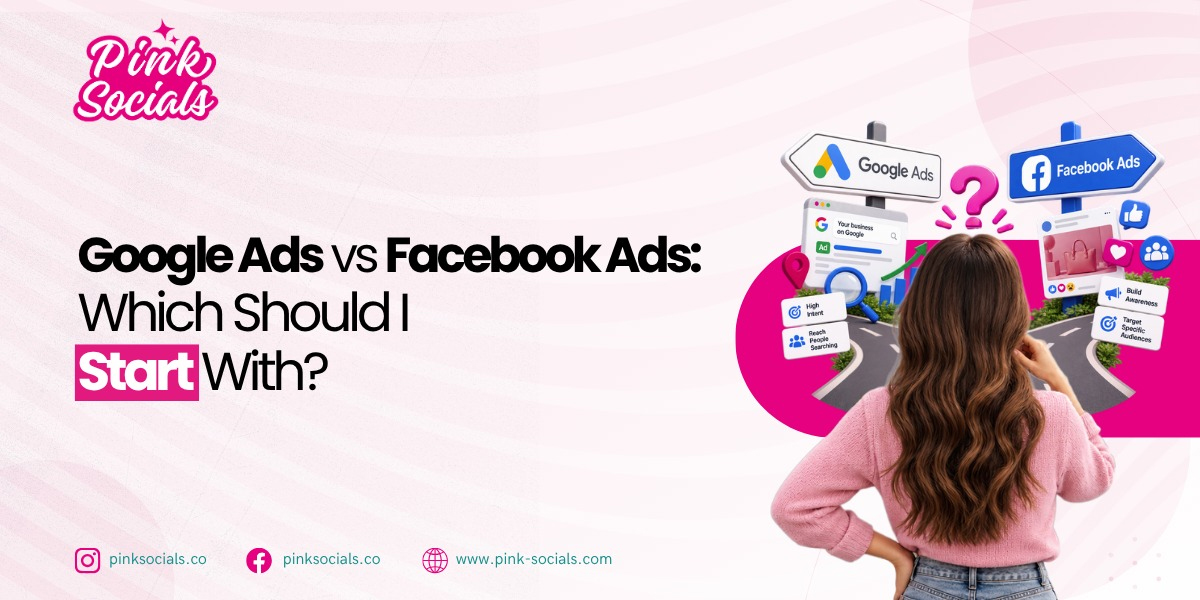
If people already search for what you sell, start with Google Ads. If you need to create demand or your product is discovered visually, start with Facebook ads. The Google Ads vs Facebook ads decision should follow how customers discover and buy from you, not which platform happens to be cheaper.
That matters when setting a realistic budget. WordStream’s 2026 PPC benchmarks analysed more than 13,000 US-based campaigns and found an average Google Ads conversion rate of 8.18%, with an average cost per click of $5.42.
In this guide, you will learn:
- How Google and Facebook ads differ in intent and audience behaviour
- Which platform fits different business goals
- How their costs and targeting options compare
- When to start with one platform instead of running both
- How to sequence your advertising budget without spreading it too thin
Google Ads vs Facebook ads: which should I start with?
Start with Google Ads if people already search for what you sell and you want to capture that intent, and start with Facebook ads if you need to create demand or your product is discovered visually rather than searched for.
Before choosing a platform, it helps to understand whether paid ads are worth it overall. Paid advertising can work well, but only when the channel matches the way your customers make decisions and the economics make sense for your business.
What is the core difference?
Google captures existing demand. Someone searching for “emergency plumber near me” or “accountant for small business” has already shown search intent. Your ad meets that person at a moment when they are actively looking for a solution.
Facebook works earlier in the journey. People are usually scrolling rather than searching. Your ad has to create interest through the offer, creative, problem or message. That makes Facebook useful for demand generation, especially when customers may not know your product exists.
| Dimension | Google Ads | Facebook Ads |
|---|---|---|
| Main role | Capture existing demand | Create demand |
| Audience mindset | Searching | Browsing |
| Strongest asset | Keywords and offer | Creative and message |
| Best fit | High-intent services and products | Discovery and visual products |
| Main challenge | Competition and CPC | Creative fatigue and testing |
Which is easier to start with?
Neither platform is automatically easier. The better starting point is the one that matches your customer’s behaviour.
A plumber with people actively searching for repairs has a clear opportunity on Google. A clothing brand launching a visually strong collection may have more room to create interest through Facebook.
That distinction also appears in a LinkedIn discussion by Kory Turrall, who recommends Google when people actively search for a specific solution and Meta when products are more desire-driven or visually compelling.
If search is clearly where your customers begin, you can also assess whether Google Ads are worth it before putting your first test budget behind a campaign. The aim is to validate demand rather than simply pick the platform everyone else is using.
Want help choosing the right starting platform for your customers and budget? Get in touch
How do cost and targeting differ between them?
Google Ads usually cost more per click but reach higher-intent buyers, while Facebook ads cost less to reach people but require strong creative and targeting to convert, so cheaper clicks do not automatically mean cheaper customers.
The difference between search ads vs social ads becomes important here because you are paying to reach people in very different states of mind.
Why can cheap clicks cost more?
A low cost per click looks attractive, but a click only has value when it has a realistic chance of becoming a lead or sale.
WordStream’s 2025 Facebook Ads Benchmarks analysed more than 1,000 campaigns and found an average Facebook traffic campaign CPC of $0.70 across industries. That is far below the $5.42 Google Ads average reported in the 2026 search benchmark.
The difference does not mean Facebook is automatically cheaper. Someone clicking a Facebook ad may only be curious. Someone searching Google for a specific service may be much closer to buying.
That is why cost per result matters more than CPC alone. A campaign generating inexpensive clicks but poor-quality leads can be less profitable than one paying more for fewer, higher-intent clicks.
For businesses considering Facebook as a primary acquisition channel, see how paid social is managed to understand how audience targeting, creative testing, conversion tracking and ongoing optimisation work together to improve campaign performance.
For example, 100 Facebook clicks that produce one qualified enquiry may be less valuable than 20 Google clicks that produce three serious enquiries. Your actual customer acquisition cost tells you much more than the headline click price.
How does targeting differ?
Google relies heavily on keywords and signals connected to what someone is searching for. Facebook gives advertisers broader ways to define audiences through interests, behaviours, demographics, custom audiences and retargeting.
That is why which is better Google or Facebook ads depends on the customer journey rather than a universal platform ranking.
| Metric | Google Ads | Facebook Ads |
|---|---|---|
| Cost per click | Usually higher | Usually lower |
| Intent | High for specific searches | Lower initially |
| Targeting | Keywords and audience signals | Interests, behaviours and audiences |
| Creative | Search copy and landing page | Image, video and carousel |
| Main optimisation | Search terms and conversion quality | Creative, audience and conversion data |
Creative also matters much more on Facebook. If someone needs to see a product demonstration, understand a problem or connect emotionally with an offer before buying, strong visuals and messaging can make a significant difference.
Before choosing Facebook as your first channel, it is worth considering whether Meta ads are effective for your particular offer, audience and conversion journey rather than judging the platform by CPC alone.
See how our Meta Ads service works for you
If Facebook fits your demand model and you want the campaign managed strategically.
Can I run both Google and Facebook ads at once?
You can run both, but a small business is usually better starting with the one that matches its demand type, proving it profitable, then adding the second, because splitting a small budget across both often means neither gets a fair test.
The goal is sequencing, not choosing one platform forever.
When does running both work?
Running both can make sense once you have enough budget, conversion data and operational capacity to manage each channel properly.
Google can capture people already looking. Facebook can introduce your offer to people who are not searching yet and bring previous visitors back through retargeting.
That wider strategy is where SEO vs ads vs social media becomes useful. Paid search can capture immediate demand, while organic search and social activity support visibility across a longer customer journey.
Community experience points in the same direction. In a Reddit discussion comparing the platforms, business owners noted that Google often suits urgent, clearly defined searches, while Meta can perform well for visually compelling or impulse-driven products.
What is the risk of doing both early?
The main risk is not simply spending more. It is collecting too little useful data from each platform.
If you split a limited monthly budget between Google and Facebook, neither campaign may receive enough conversions to show what is actually working. You may start changing audiences, creative and bids before there is enough evidence to make a sound decision.
| Stage | Run this | Add later |
|---|---|---|
| Clear search demand | ||
| Visual or discovery-led product | ||
| Limited budget | One platform | Second after profitability |
| Proven acquisition channel | Winning platform | Second for growth |
Once you have a stronger paid strategy, you can also explore full ad management rather than trying to optimize several channels without enough time or data.
As your audience strategy expands, knowing which social platforms to use can also help you decide where your wider social presence should support paid campaigns.
Compare our simple monthly plans
If you are ready to understand the cost of getting your advertising managed.
Conclusion
Google and Facebook are not interchangeable. Google is strongest when customers already know what they need and are actively searching. Facebook is stronger when you need to introduce an offer, create interest or reach people before they search.
The best starting point is your demand type, not the platform with the cheapest click. If your budget is limited, prove one channel first, learn what converts, then add the second when you can fund and measure it properly.
For businesses that want a clearer paid advertising strategy, Pink Socials can help turn that decision into a practical campaign plan.
Leave a Reply