
How Much Should a Small Business Spend on Ads?
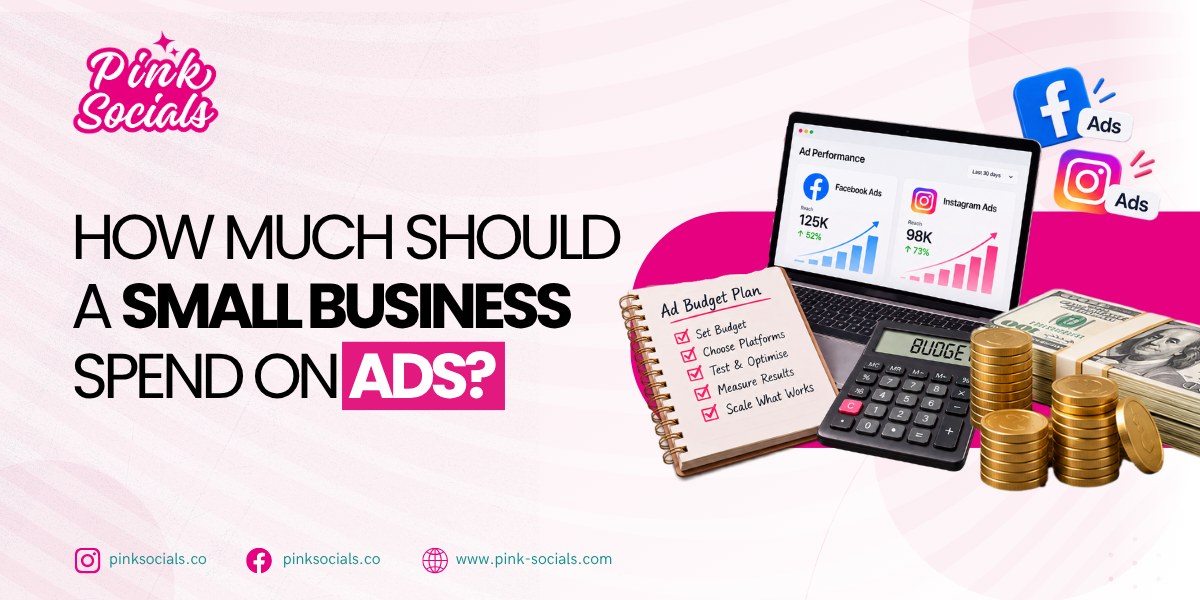
Set an ad budget too low and you may never collect enough data to know if a campaign works. Set it too high and you can lose money before you understand what is driving results. So, how much should a small business spend on ads?
There is no single dollar amount that works for every business. In Intuit’s 2025 Small Business Advertising Trends Report, the estimated average small-business advertising budget was about $78,000 for the year. However, that figure is based on surveyed businesses and should not be treated as a starting point for every company.
The better approach is to work backward from your goal, expected customer value, and acceptable acquisition cost.
This guide explains:
- How to set an ad budget by goal
- How much you need for a meaningful test
- Why a percentage of revenue is only a rough guide
- How to scale profitable campaigns
- When to reduce or stop ad spend
How Much Should A Small Business Spend On Ads?
A small business should spend enough to give one channel a fair test based on its cost per lead and business goal, rather than choosing a fixed dollar amount and hoping it works.
The right budget depends on what you sell, how much a customer is worth, your conversion rate, and how quickly you need results. A business selling a $50 product cannot use the same economics as a company selling a $5,000 service.
Before choosing a figure, decide what the advertising needs to achieve.
Should I Use A Percentage Of Revenue?
A percentage of revenue can provide a rough planning framework, but it should not determine your entire advertising budget.
For example, Gartner’s 2026 CMO Spend Survey found that marketing budgets averaged 7.8% of company revenue among the organizations surveyed. However, the survey covered 401 CMOs and marketing leaders, with most respondents representing companies generating more than $1 billion in annual revenue. That makes it useful context, but not a direct small-business benchmark.
Your budget should instead reflect your economics. If your gross profit allows you to acquire a customer for $200 and your campaign consistently produces customers below that level, increasing spend may make sense.
A separate testing budget can help you evaluate a new channel without putting your entire monthly advertising allocation at risk.
If you are still working out whether advertising deserves a place in your wider marketing mix, start by considering whether paid ads are worth it overall rather than choosing a budget in isolation.
What Is The Goal-Based Approach?
Start with the number of customers you want, then work backward.
Suppose you want 20 new customers per month. If your sales process converts 25% of qualified leads into customers, you need approximately 80 qualified leads.
If your acceptable cost per lead is $40:
80 leads × $40 = $3,200 monthly ad budget
That does not mean you should immediately spend $3,200. It gives you a target to compare against actual campaign performance. Your channel choice matters too. If you are considering paid social as part of that budget, review whether Meta ads are effective to understand when Facebook and Instagram campaigns are more likely to make commercial sense.
You can use part of that amount as a testing budget first, then increase the allocation once the campaign demonstrates that its economics are viable.
| Goal | What To Calculate | Example Planning Figure |
|---|---|---|
| Generate Leads | Leads Needed × Target CPL | 80 × $40 = $3,200 |
| Generate Customers | Customers Needed × Target CAC | 20 × $160 = $3,200 |
| Test One Channel | Expected Leads × Acceptable CPL | 30 × $40 = $1,200 |
| Protect Profitability | Revenue × Acceptable Acquisition Ratio | Based On Margins |
The important point is that the number should come from your business model, not an arbitrary recommendation such as “$1,000 per month for every small business.”
Your target ROAS should also reflect your margins and customer value, because a campaign can generate revenue while still failing to produce enough profit.
Need Help Turning Your Goals Into A Realistic Budget?
Get A Budget Recommendation based on your goals, offer, and expected acquisition economics.
What Is The Minimum Budget For A Fair Test?
The minimum budget for a fair test is enough to gather sufficient clicks and conversions to judge the campaign, because too little spend produces noisy data and can make a potentially good campaign look unsuccessful.
There is no universal minimum. A niche B2B service may need more time and spend to generate meaningful leads than an inexpensive e-commerce product.
Why Can Too Little Spend Fail?
A tiny budget can create a misleading picture.
Imagine spending $100 and receiving two clicks. You cannot reasonably conclude that the campaign does not work. You simply do not have enough evidence.
The same applies when you test too many campaigns at once. Splitting a small budget across five audiences and six creatives can leave every variation starved of data.
This is where your small business advertising budget should be concentrated rather than scattered across every available platform.
Your testing budget should therefore be large enough to generate useful conversion data while remaining small enough to limit the downside if the initial approach does not work.
A useful principle is:
One Goal + One Primary Channel + A Manageable Number Of Tests = Clearer Data.
You also need to separate media spend from management costs. If you are considering outside support, knowing what an agency costs can help you decide how much of your overall marketing budget should go toward advertising itself and how much toward campaign management.
If search is the channel you are considering, you can also review whether Google Ads are worth it before dividing a limited budget between multiple platforms.
How Long Should A Test Run?
Run a campaign long enough to collect meaningful conversion data, not just enough to generate impressions or clicks.
Your test window depends on:
- Average order value
- Lead volume
- Conversion rate
- Sales cycle
- Audience size
- Campaign objective
- Available budget
A campaign that generates several qualified leads every week can be evaluated faster than one selling a high-value service with a long sales cycle.
| Channel | Data Needed | Practical Test Principle |
|---|---|---|
| Search Ads | Search Volume And Conversions | Allow Enough Time For Qualified Searches |
| Social Ads | Engagement And Conversions | Test Multiple Creative Concepts |
| Lead Generation | Qualified Leads | Measure Lead Quality, Not Volume Alone |
| E-commerce | Purchases | Compare Acquisition Cost With Margin |
Your testing spend should also fit within a broader marketing budget, especially if you are paying for campaign management alongside the advertising itself.
Compare Our Simple Monthly Plans
Do not judge a campaign solely because the first few days produced an expensive click. Early results can fluctuate considerably.
Look at ROAS alongside conversions and lead quality once enough data is available, rather than making a decision from clicks or impressions alone.
Recent small-business discussions show just how different real budgets can be. In a January 2026 Reddit discussion about advertising spend, one business owner said they spent around $800 per month on ads but had started at $200. Another reported spending nothing on ads and relying on other marketing activities. These are individual experiences, not benchmarks, but they reinforce the point that budget decisions depend heavily on the business and its economics.

How Do I Scale Ad Spend Without Wasting Money?
Scale ad spend by increasing budget only on campaigns already producing profitable results, then raise spending gradually so performance can be monitored instead of assuming more budget automatically means more profit.
This is where scaling becomes different from simply spending more.
How Fast Can I Scale?
Avoid making large budget increases just because a campaign has produced a few good results.
A campaign might generate five customers one week and struggle the next. Before increasing spend, look for consistency in:
- Lead volume
- Lead quality
- Customer acquisition cost
- Conversion rate
- ROAS
- Sales close rate
- Gross profit
For example, if a campaign consistently generates customers at $150 while your break-even acquisition cost is $250, you have room to test additional spend.
If costs are already close to $250, increasing the budget aggressively could push the campaign into an unprofitable position.
The goal is not maximum spending. It is maximum profitable spending.
When Do I Cut A Campaign?
Cut or restructure a campaign when it has had a fair test and continues to produce results above your break-even point.
Do not automatically stop an ad because its click-through rate is lower than another ad. A campaign with fewer clicks can still produce better customers.
Check ROAS against your profit margin and break-even point before deciding whether the campaign deserves more budget or needs to be rebuilt.
| Signal | Decision | Why |
|---|---|---|
| Leads Below Target Cost | Scale Carefully | Campaign Has Room To Grow |
| Leads Near Break-Even | Hold | Gather More Data |
| Leads Above Break-Even | Review | Identify The Bottleneck |
| Poor Lead Quality | Fix Targeting Or Offer | Cheap Leads Are Not Necessarily Valuable |
| No Meaningful Conversions | Cut Or Rebuild | Spend Is Not Producing Useful Evidence |
Your ad budget for small business should therefore be flexible. Increase it when the economics support growth and reduce it when the numbers stop making sense.
Research also supports the importance of measurement when budgets are constrained. Gartner’s 2025 CMO Spend Survey Findings that 59% of CMOs said they had insufficient budget to execute their strategy, while data, analytics, and measurement were among the actions being used to improve productivity.
That principle applies at a smaller scale too. When money is limited, knowing which campaigns actually produce customers becomes more important, not less.
If you want to see how budgets can be structured across different marketing activities, you can see how ad budgets are planned and managed before deciding how much to put behind one channel.
Likewise, if your budget is limited, choosing services for your budget can help you prioritize the work most likely to support your current growth stage.
Conclusion
The right advertising budget is not a universal monthly figure. It should come from your business goal, acceptable acquisition cost, margins, conversion rate, and available cash flow.
Start with a focused test. Measure actual customer outcomes. Protect your break-even point, then increase scaling only when the campaign consistently produces profitable results.
The businesses that get the most from advertising are not necessarily the ones spending the most. They are the ones that understand where each dollar goes and whether it comes back with a worthwhile return.
If you need help turning that approach into a practical advertising plan, Pink Socials can help.



Leave a Reply