
Why Does My Website Get Traffic But No Customers?
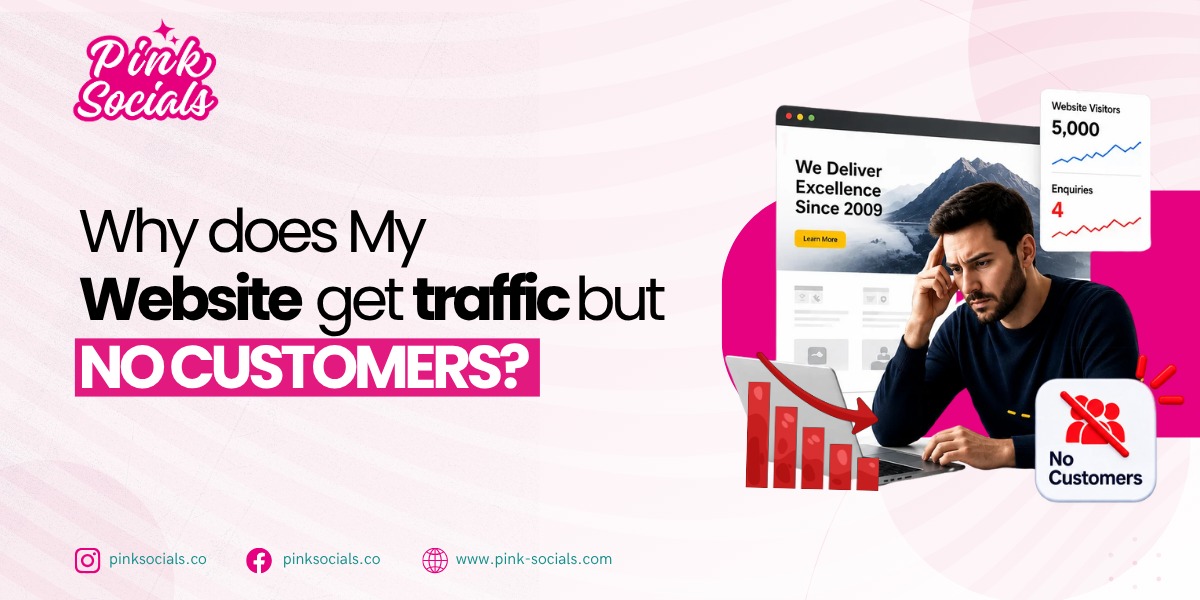
Your analytics show visitors arriving, maybe even climbing, but your phone is not ringing and the contact form stays quiet. Website traffic but no customers usually means something is breaking between the click and the action you actually want.
The mobile experience deserves particular attention. Statista’s 2026 mobile internet data reports that mobile devices accounted for 58.5% of global website traffic in 2025, making mobile usability a conversion issue, not just a design preference.
In this guide, you will learn:
- How to tell whether your traffic is the problem
- Which conversion killers are hurting your pages
- How speed and mobile experience affect results
- Which fixes can turn existing visitors into leads
Why does my website get traffic but no customers?
A website gets traffic but no customers when the traffic does not match your offer, or the page fails to make the next step obvious, trusted, and easy, so visitors leave without ever contacting you.
If you are seeing website traffic but no customers, do not assume you simply need more visitors. First determine whether the people arriving actually match your offer, then check whether the page gives them a clear and trustworthy reason to take action.
Start by separating a traffic problem from a conversion problem. If people are searching for information rather than buying, sending more of them to the same page will not solve much. If the right people are arriving but leaving, your website needs attention.
Before changing your marketing, it is useful to look at the digital marketing services a small business needs, because traffic sources, messaging and website performance should work together rather than being treated as separate problems.
Is my traffic the right traffic?
Look at where visitors come from and what they searched before landing. A page targeting “how to fix a leaking tap” may attract people looking for instructions, while a plumbing service wants people ready to book.
The same problem happens with broad paid campaigns, social posts and informational SEO pages. High traffic numbers can look impressive while producing very few commercial visitors.
| Symptom | Root cause | First fix |
|---|---|---|
| Lots of visitors, few enquiries | Weak intent match | Review keywords and traffic sources |
| Traffic from unrelated searches | Wrong audience | Tighten targeting and page relevance |
| Good traffic but short visits | Expectation mismatch | Align headline and landing page |
| Product pages get visits but no sales | Conversion friction | Review offer, proof and CTA |
Is my page the problem?
If the right people arrive and still do nothing, look at the page before buying more traffic.
The headline should quickly explain what you offer and who it is for. The content should answer the visitor’s immediate questions. Your call to action should make the next step obvious.
A recent LinkedIn discussion makes the same distinction, arguing that businesses often mistake a conversion problem for a traffic problem when unclear messaging, weak CTAs, poor page structure and missing trust signals are stopping visitors from acting.
If you have already established that the right people are reaching your site, getting a second opinion can be more useful than simply increasing traffic.
Not sure whether the problem is your traffic or your website? Get in touch for a clearer starting point before you spend more on acquisition.
What on my page is stopping visitors from converting?
Visitors fail to convert when the offer is unclear, the call to action is weak or buried, there is no trust or proof, or contacting you takes too many steps, especially on mobile where many visitors now arrive.
These are common website conversion problems, but they are usually visible once you stop looking only at sessions and start examining what visitors do after landing.
What is a weak call to action?
A CTA should tell visitors exactly what happens next. “Learn more” is vague when the real goal is to book a consultation. “Request a free quote” is much clearer when that is the action you want.
Keep the primary action visible without filling every section with competing buttons. This is a practical conversion rate optimization issue: the goal is to remove hesitation and make the intended action obvious. A service page might need one main action such as booking a call, requesting a quote or starting an enquiry.
Your landing pages should also match the promise that brought the visitor there. If an ad promises a free consultation but the landing page opens with a generic company introduction, the visitor has to work to connect the two.
That is why it is worth reviewing what makes a website actually convert when your pages receive attention but fail to generate meaningful actions. The strongest conversion improvements usually come from clarity, relevance, trust and reduced friction, not from making a page look more complicated.
Why does trust matter so much?
A visitor who does not know your business needs reasons to believe you can deliver what you promise. Good UX design supports that trust by making important information easy to find and the next step easy to understand.
Show relevant reviews, testimonials, case studies, credentials, guarantees, recognizable clients or clear service information where appropriate. Do not hide every trust signal on a separate page. Put enough evidence close to the decision point.
Baymard Institute’s UX research found that 19% of US online shoppers abandoned an order because they did not trust the site with their credit card information. Its research focuses on ecommerce, but the broader lesson applies to conversion design: uncertainty creates friction.
The fix is not adding twenty testimonials to every page. It is giving visitors the specific proof they need at the moment they are deciding whether to continue.
If your pages need stronger structure, messaging and conversion paths, see how our Web Design service works for you and see what a conversion-focused approach can change.
How do speed and mobile issues cost me customers?
Slow load times and clumsy mobile layouts cost customers because visitors often browse on phones and leave when a page is slow or difficult to use, so page speed and mobile experience are conversion issues, not just technical details.
A beautiful page that takes too long to load still loses the visitor before they see the offer. A fast page with buttons that are difficult to tap creates a different kind of friction.
How fast is fast enough?
Do not treat speed as an isolated technical score. Look at what happens to real visitors.
Compress oversized images, remove unnecessary scripts, reduce page weight and make sure important content loads quickly. Then check performance on the devices your customers actually use.
If you want to understand the commercial side of the issue, how site speed affects sales is worth examining alongside your analytics. A speed problem matters most when it prevents visitors from reaching the information or action that could have produced a lead.
Baymard’s latest checkout research also found that 17% of US online shoppers had abandoned an order because the checkout process was too long or complicated. That figure is ecommerce-specific, but it illustrates a wider principle: every unnecessary step gives a motivated visitor another opportunity to leave.
Why is mobile so critical?
Mobile users should not have to pinch, zoom, hunt for buttons or fight a form.
Check your homepage, service pages and contact process on an actual phone. Can someone understand the offer quickly? Is the CTA easy to tap? Does the phone number work? Can a form be completed without excessive typing?
A recent Reddit discussion from a business owner experiencing strong traffic but almost no sales raised exactly these questions, including mobile experience, weak CTAs, trust signals, page presentation and checkout friction.
Mobile is not a separate version of your website. For many visitors, it is the website.
| Issue | Effect on conversion | Fix |
|---|---|---|
| Slow page | Visitor leaves before content loads | Reduce page weight |
| Tiny buttons | Taps become frustrating | Increase tap targets |
| Long forms | More abandonment | Remove unnecessary fields |
| Poor mobile layout | Offer becomes hard to understand | Simplify responsive design |
| Slow checkout | Purchase intent drops | Reduce steps and friction |
How do I turn my website traffic into customers?
Turn traffic into customers by matching pages to what visitors want, leading with one clear offer and call to action, adding proof, making contact easy on mobile, fixing speed, and measuring form fills, calls and sales.
The goal is not to redesign everything immediately. Start with the page where visitors show the strongest intent. If your website not converting issue is limited to one or two high-traffic pages, you may be able to fix it without a full redesign. If you are unsure what needs fixing, get a free website review to identify the main conversion barriers.
What is the fastest conversion win?
Start with your highest-traffic page that also has commercial intent. Review your highest-performing landing pages first, because improving a page that already attracts relevant visitors can produce a faster result than rebuilding low-traffic pages.
Rewrite the headline so the value is obvious. Put the primary CTA where visitors can see it without searching. Add relevant proof. Remove distracting navigation or competing actions where they interfere with the main goal.
Then measure the result. Track enquiries, calls, bookings, purchases or whatever action represents real business value. A higher conversion rate optimization result is useful only when it produces better business outcomes.
If your site generates leads, you should also consider the best way to generate leads alongside your website changes. The strongest lead strategy connects acquisition, landing pages, follow-up and measurement rather than expecting one page to do everything.
When is the site beyond quick fixes?
Sometimes the problem is structural. If page speed remains poor across multiple important pages despite basic optimisation, the issue may be deeper than one oversized image or unnecessary script.
Your navigation is confusing, the CMS makes updates difficult, the mobile experience is fundamentally broken, pages load slowly across the site, or the content structure no longer matches what customers need.
That is when a rebuild can make more sense than endlessly patching individual pages.
Before spending more to bring visitors to a weak experience, also ask are paid ads worth it for your business right now. If the website cannot convert existing high-intent traffic, increasing paid acquisition may simply increase the amount of traffic entering the same leaky funnel.
| Step | Action | Metric |
|---|---|---|
| 1 | Check traffic intent | Qualified visits |
| 2 | Review top landing page | Engagement and exits |
| 3 | Clarify the offer | CTA clicks |
| 4 | Add relevant proof | Enquiries or bookings |
| 5 | Improve mobile and speed | Engagement and conversion |
| 6 | Measure changes | Leads, sales and conversion rate |
If the structure, UX and conversion path need a deeper rebuild, see how a converting website is built before putting more money into traffic.
If you are considering ongoing digital marketing support, Compare our simple monthly plans to see the available options before deciding what level of support you need.
Conclusion
Traffic without customers does not automatically mean you need more traffic. First determine whether the people arriving are the right audience. If they are, look at what happens after they land: unclear messaging, weak CTAs, missing trust, slow pages, poor mobile UX design and unnecessary friction can all stop good visitors from becoming leads.
The good news is that you do not have to rebuild everything at once. Start with intent, clarity, the primary action, trust and the biggest usability barrier. Then measure whether those changes improve the actions that matter to your business.
A website should do more than attract visitors. It should give the right visitors a clear reason and an easy path to become customers. Pink Socials can help turn that traffic into a more effective conversion journey.
Leave a Reply